Improving Dialogues in LLM-Based AIWolf Agents With Few-Shot Discussion Examples
What we did
When LLM agents talk to each other, each utterance is natural, yet discussions stall, earlier remarks and questions are ignored, agents agree too readily, and role-appropriate behavior is lacking. A single LLM writing a whole dialogue, on the other hand, produces a natural conversation.
So we had a single LLM write an entire five-player game (roles, daily talk, votes, and divinations) and placed such games in each agent’s context at the start of play: not isolated utterances, but the flow of a full discussion. Instead of showing everyone the same examples, each agent sees examples in which its own role is the protagonist (4 roles × 5 situations).
Results
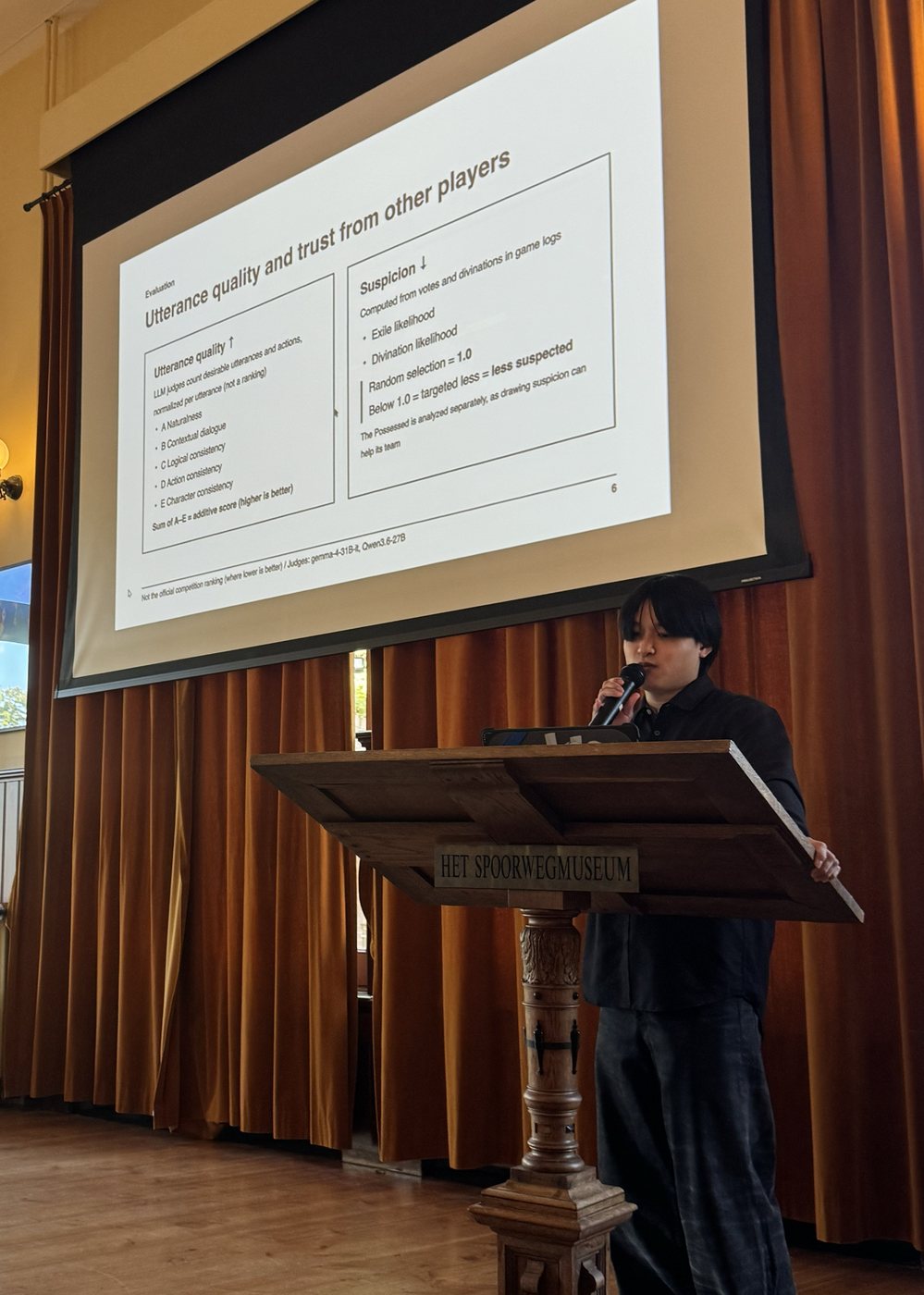
- Across competitions — compared with the domestic contest, where we used the same examples for all roles, the LLM-judged utterance quality score rose from 0.384 to 0.584 and 0.555 in the international contest with role-specific examples, and the agents were chosen less often for exile and divination. The competitions also differed in LLMs and opponents, so this alone cannot isolate the effect of the examples.
- Controlled experiment — in self-play varying only the examples (3 models × 5 conditions × 10 games), utterance quality was 0.262 with role-matched examples, 0.243 with examples for another role, and 0.234 with none. Role-matched examples also made agents less suspected by other players.
- Limitation — all five examples for the Possessed included a false Seer claim, but agents made one in only 14.7% of cases. A demonstrated strategy is not necessarily chosen when it is needed.